If you’re sensitive to FODMAPs—the fermentable carbs that can trigger bloating, gas, and abdominal discomfort in people with IBS or similar gut issues—this recipe deserves a quick reality check before you dive in. The low‑FODMAP approach typically starts with an elimination phase and then carefully reintroduces foods to identify personal triggers. Black beans are commonly a higher‑FODMAP food, and this version also includes onion and garlic, which many low‑FODMAP eaters find especially reactive. That said, you can often make bean dishes more tolerable by sticking to small portions, using overnight-soaked and thoroughly rinsed beans, and (3) swapping the highest-trigger aromatics—try garlic‑infused oil instead of garlic and green onion tops/chives instead of onion (same flavor vibe, usually easier on sensitive guts). If you’re experimenting, treat this as a “low‑FODMAP‑aware” recipe rather than strictly low‑FODMAP, and adjust based on your own tolerance.
First, the terms: FODMAPs, IBS, and fructans
The intro leans on a bit of jargon—here’s the plain-English version.
- FODMAP stands for Fermentable Oligosaccharides, Disaccharides, Monosaccharides, And Polyols—a family of short-chain carbohydrates that are poorly absorbed in the small intestine and then fermented by bacteria further down. The term and the low-FODMAP diet were developed at Monash University as a symptom-management tool for IBS—not a general healthy-eating plan for everyone.
- IBS (Irritable Bowel Syndrome) is a common functional gut disorder—abdominal pain, bloating, gas, and altered bowel habits (diarrhea, constipation, or both) with no structural damage. Its hallmark is visceral hypersensitivity: the gut over-reacts to the normal stretching and fermentation that most people never even notice.
- Fructans are the “O” in FODMAP (fermentable oligosaccharides)—chains of fructose found in wheat, rye, onions, garlic, leeks, asparagus, and artichokes. Humans don’t make the enzyme to break them down, so they pass intact into the large intestine and get fermented there.
Fructans aren’t the villain—for most people
Here’s the part that usually gets lost. In a healthy gut, that fermentation is a feature: fructans act as prebiotics, feeding beneficial bacteria and fueling the short-chain fatty acids that keep the colon lining healthy. Most people eat onions, garlic, and wheat with little to no symptoms—and a real microbiome benefit.
The trouble is specific to people with IBS or fructan intolerance. In a hypersensitive gut, the gas and the water that fermentation pulls into the bowel turn into bloating, cramping, distension, and irregular stools. Same biology, very different experience.
A few things worth clearing up:
- Fructans ≠ gluten. Plenty of people blame wheat’s gluten when they may actually be reacting to its fructans—which is why some feel fine on gluten-free bread (fructans reduced) yet bloated by ordinary wheat. Fructan sensitivity is not celiac disease; they’re separate issues.
- No symptoms? No need to avoid these foods. Without IBS or fructan intolerance, there’s generally no reason to skip garlic, onions, wheat, or artichokes—they’re nutritious and good for your microbiome.
- Onions and garlic are among the strongest fructan sources there are. So if those reliably set you off while other foods don’t, fructans are the likely suspect—worth a structured low-FODMAP trial with a professional rather than a guessing game.
Which is exactly why this recipe flags its onion and garlic up top and offers garlic-infused oil and green-onion tops as swaps: fructans are water-soluble, so infusing garlic in oil carries the flavor while leaving the fructans behind, and the green tops of scallions are low-fructan where the white bulbs are not.
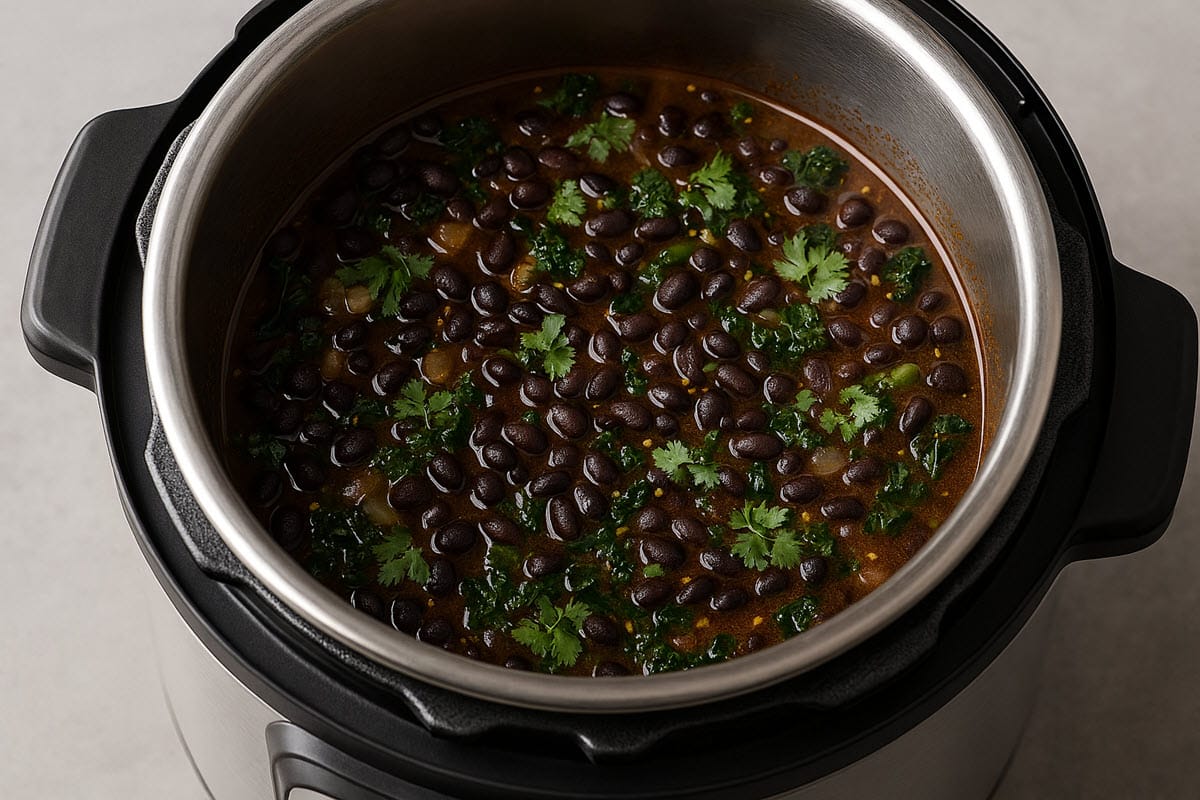
Spicy Instant Pot Black Beans
Digestive-Friendly, Vegetable-Boosted Version
Spicy Instant Pot Black Beans with Ginger, Turmeric & Kale
A digestive-friendly, vegetable-boosted pot of black beans—the beans pressure-cooked and drained first for easy digestion, then simmered with a cumin-ginger-turmeric base and finished with kale and lime.
Ingredients
Equipment
- Instant Pot or other electric pressure cooker
Method
- Wash the black beans and soak them in plenty of water with the baking soda for .
- Drain, then rinse and wash the beans well under fresh water.
- Add the beans to the pressure cooker with 6–8 cups fresh water, the bay leaves, dried red chilies, fenugreek seeds, and salt. Pressure cook on high for , then let the pressure release naturally. Drain in a colander, discarding the cooking water, bay leaves, and chilies.
- Wipe out the pot (or use a large skillet) and set to Sauté. Add the oil, then the cumin and fenugreek seeds, and toast until fragrant (do not brown). Lower the heat and add a pinch of asafoetida (hing); let it bloom a few seconds until aromatic (optional, but it helps tame bean gas—see below).
- Add the onion and jalapeño. Cook until soft and translucent.
- Add the garlic and ginger and cook until aromatic.
- Add the turmeric and smoked paprika. Stir constantly for to bloom the spices and activate turmeric’s fat-soluble compounds.
- Add the cooked beans, chicken broth, and Better Than Bouillon (loosen with a splash of water if needed). Simmer to marry the flavors—no need to pressure cook again, the beans are already tender.
- Stir in the chopped kale while the beans are hot. Cover and let it wilt for .
- Season with salt to taste and lime juice. Garnish with a drizzle of olive oil, parsley, and cilantro.
Notes
- Cook the beans first, then build the dish. Cooking them separately in plain water lets you drain off the degassing cooking liquid, and it keeps the beans from toughening in the salty, acidic sauce.
- Digestibility: add the baking soda to the SOAK only—not the cook. Draining the soak water and rinsing well carries off most of the gas-causing sugars; more baking soda in the pot can turn the beans mushy and taste slightly soapy.
- Soak plus pressure cooking is also what defuses the lectins—a slow cooker doesn’t get hot enough.
- A pinch of hing (asafoetida) bloomed with the seeds in the tempering step helps tame bean gas; a pure or well-compounded brand works best.
- Start with a moderate portion (½–1 cup cooked beans). Many people build better tolerance by eating beans regularly.
- Low-FODMAP-aware swaps: garlic-infused oil instead of garlic, and green-onion tops instead of onion.
A pinch of hing: the Indian trick for gas-free beans
Indian kitchens have been solving the bean-and-gas problem for centuries, and the fix is a single spice: asafoetida, better known as hing. A tiny pinch pulls double duty—it lends a savory, onion-and-garlic depth (handy if you’re skipping those aromatics for FODMAP reasons, as noted up top) and its digestive compounds genuinely help tame the bloating and gas legumes are famous for.
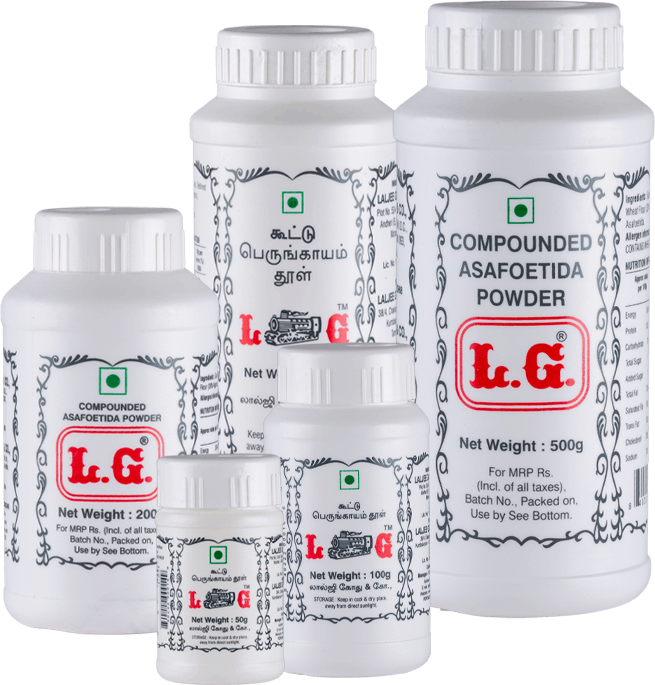
Compounded asafoetida (hing) powder. Image courtesy of Laljee Godhoo (L.G.).
The catch is when you add it. Hing needs heat and fat to bloom—raw, it’s harshly pungent and a little bitter. The traditional, most effective move is the tadka (tempering):
- Heat a little ghee or oil, add cumin or mustard seeds, and let them splutter.
- Drop the flame, add a tiny pinch of hing, and let it bloom just a few seconds until fragrant.
- Pour that straight over the cooked beans—or stir the beans into it.
Good news: this recipe already hands you the moment. The tempering step—toasting cumin and fenugreek seeds in oil—is a tadka. Just add a small pinch of hing right there with the seeds, keeping the heat gentle so it doesn’t scorch. (Skip adding it to the bean-soaking water or the cooking water you’ll drain off, and skip it raw at the table—it needs fat and heat to turn pleasant and functional.)
A few notes straight from Indian practice:
- A pinch is plenty for a whole pot—too much turns the dish bitter and medicinal.
- It plays well with the digestive spices already in here—cumin, ginger, bay—and with ajwain if you keep it around.
- Still soak, discard the soak water, and rinse (which this recipe does); hing is the finishing touch, not a substitute for good prep.
- Quality varies—cheaper hing is cut heavily with flour—so a pure or well-compounded brand like Laljee Godhoo is worth seeking out.
It dovetails neatly with everything below: soak + pressure-cook handles the lectins; a pinch of hing handles the gas.
Turmeric + fenugreek: the colloid connection
This recipe leans on turmeric and fenugreek together, and that pairing turns out to be more than a flavor choice. In What Happens To Your Body If You Eat Turmeric For 30 Days?, Dr. Sten Ekberg argues that the combination is what unlocks turmeric’s real benefits—far more than plain turmeric or the usual turmeric-plus-black-pepper trick.
▶ Watch Dr. Ekberg’s video on YouTube — the uploader has embedding turned off, so it won’t play inline.
The absorption problem. Curcumin—turmeric’s active compound—is fat-soluble and poorly absorbed. Per Dr. Ekberg, less than 1% of plain turmeric makes it into your blood; black pepper (piperine) nudges that to only ~5–8%, and the liver clears most of what does get through before it reaches your cells.
Where fenugreek comes in. Fenugreek’s soluble fiber (a galactomannan) wraps curcumin in a protective colloidal matrix—making it more water-compatible, shielding it from rapid breakdown, and releasing it slowly. Dr. Ekberg puts the payoff at roughly 15–30% absorption and ~25–40× more curcumin reaching the cells than turmeric alone or with pepper—enough to matter where curcumin actually works. He points to a concentrated, fenugreek-complexed supplement (Turmeric Forte) as the practical way to hit those levels with a small dose.
The benefits he stacks up scale with that absorption:
- In the gut (even at modest absorption): feeds good bacteria, firms up the gut barrier against leaky gut, calms gut inflammation, and improves bile flow and fat digestion.
- In the blood: antioxidant activity and lower inflammatory markers (CRP, TNF-α, IL-6).
- In the cells (the big ones, which need the fenugreek boost): dials down NF-κB and up NRF2, protects mitochondria, raises glutathione, and—crossing the blood-brain barrier—supports BDNF and neuroplasticity, plus insulin sensitivity and liver health.
Over ~30 days he’d expect better digestion and less bloating in the first week or so, then—by 3–4 weeks—less stiffness, clearer thinking, and steadier energy.
You already get a little of this synergy here: the beans cook with fenugreek seeds, and the dish blooms turmeric in fat to help its fat-soluble compounds along. To lean into Dr. Ekberg’s version, let the fenugreek fully hydrate—soaking or simmering the seeds is what forms the colloid—so it’s there to partner the turmeric rather than just season it. (A kitchen pot won’t match a concentrated supplement’s dose, but the pairing is the same idea.)
As with the other voices here, this is Dr. Ekberg’s framing, not settled medical fact—a good reason to enjoy the pairing, not a prescription.
Where black beans land on the Intestinal Profile plate
There’s a second lens worth holding up next to the FODMAP one—and for once it points the other way. In Carolyn Mein’s Different Bodies, Different Diets (the 25 Body Type System), each type gets its own Intestinal Profile food list that sorts foods not into “good” and “bad,” but by how often that type tends to do well eating them. The tiers are simple:
- Ultra Support / Frequently — 3–7 meals a week
- Basic Support / Moderately — 1–2 meals a week
- Stressful / Rarely — no more than once a month
That frequency, Mein notes, refers to each food on its own—not the whole category. So a food in the top tier isn’t “legumes in general are fine”; it’s that this specific food earns a place on the plate several times a week.
Here’s the part that makes this recipe more than a guilty pleasure: on the Intestinal type’s Healthy Food List, black beans sit in the top tier—Ultra Support / Frequently. Right there under Legumes: beans (black, lima [butter], pinto), lentils. For this type, in other words, a pot of black beans isn’t an occasional indulgence to ration—it’s a staple the body is built to run on 3–7 times a week.
The catch that reconciles both lists
That top-tier ranking comes with an honest asterisk, and it’s the same wisdom the FODMAP note opened with. Mein’s list has two versions: a Healthy list for when you’re digesting well, and a Sensitive list for when you’re stressed or your gut is struggling. On the Sensitive list, black beans slide down a notch to Basic Support / Moderately (1–2 meals a week)—and only pinto beans hold the top spot.
So both lenses land in the same place. When your gut is happy, black beans are a frequent, supportive food—lean in. When it’s not, ease off: smaller portions, well-soaked and thoroughly rinsed beans, the garlic-infused-oil and green-onion swaps above, or lean on gentler pinto beans until things settle. The recipe doesn’t change; how often you reach for it does.
The beans are the headline, but here’s how the whole pot scores for the type:
Solidly type-aligned — every food is “Frequently” or “Moderately” on a good day (5 in the top tier) and none are “Rarely” foods, though several ease back under stress.
- Black beans Frequently
- Butter Frequently
- Onions (chives, green, red, white, yellow, vidalia) Frequently
- Brown onions Frequently
- Garlic Frequently
- Chicken broth Moderately holds under stress
- Kale Moderately holds under stress
- Chili peppers Moderately
- Limes Moderately holds under stress
- Olive oil Moderately holds under stress
- Parsley Moderately holds under stress
- Cilantro Moderately holds under stress
- Salt Moderately holds under stress
Scored against Carolyn Mein’s Intestinal Profile. See the full Healthy vs. Sensitive crosswalk.
Curious which type you are? We wrote up the sensitive, big-hearted Intestinal body type here.
Eating for that type today? Tap Intestinal on the recipe card above and three ingredients tune to the top of Mein’s list — ghee for the fat, brown onion, and a lighter hand on the jalapeño. Tap Base recipe to switch back.
The “natural Ozempic” angle: beans and your own GLP-1
There’s another reason a humble pot of beans punches above its weight. Dr. Bazgha Khalid, MD—board-certified in internal medicine and obesity medicine—makes the case that beans gently support your body’s own GLP-1, the same fullness hormone that medications like Ozempic mimic. Her framing is refreshingly honest: beans are not a stand-in for a prescribed GLP-1 drug and won’t deliver that strong, sustained appetite suppression. What they offer is a milder, everyday-biology version of the same effect—for about a dollar a can.
Three mechanisms do the work:
- Fiber slows digestion. A cup of beans carries roughly 13–15 grams of fiber—often more than a full day’s worth for many people. Fiber absorbs water and forms a gel that slows how fast food leaves your stomach, echoing the way GLP-1 drugs delay gastric emptying so you feel full longer.
- Resistant starch feeds your gut and cues natural GLP-1. Some of the starch in beans resists digestion and travels to the large intestine, where friendly bacteria ferment it into short-chain fatty acids like butyrate. Those act as a signal to the gut’s L-cells, prompting them to release your own GLP-1.
- Protein adds to satiety. Beans bring around 15 grams of plant protein per cup, which further supports lasting fullness.
The downstream benefits she notes track with the wider evidence on beans: steadier post-meal blood sugar and better insulin sensitivity over time, a well-fed microbiome (beans are a prebiotic, and those short-chain fatty acids nourish the colon lining and calm inflammation), and the heart, cholesterol, and colon-health patterns seen in bean-heavy Mediterranean and Latin American diets.
A few practical notes from the video that fit this recipe well:
- Start small—about half a cup a day—and build up gradually if your gut isn’t used to the fiber, with plenty of water to keep bloating down. (Consistency is what settles the initial gas; the microbiome adapts.)
- Rinse canned beans to cut sodium and some of the gas-causing compounds—the same rinse this recipe already calls for on soaked beans.
- Cooling cooked beans—say, in a next-day salad—actually increases their resistant starch.
- Rotate varieties—black beans, pinto, chickpeas, lentils, kidney—for broader microbiome benefit. (Which, neatly, is exactly what the Intestinal Profile list above rewards.)
One honest caveat, straight from Dr. Khalid: this is educational, not medical advice. Beans support the GLP-1 system naturally and far more gently than an injectable—so if you have a health condition or take medications, talk to your doctor before making big diet changes.
What four other practitioners say
Black beans get a nod from doctors working in very different frameworks—keto, the blood type diet, gut health, and metabolic/kidney care. They don’t all agree, and that’s the useful part: where four different lenses point at the same humble food, it’s worth noticing. (A fair-warning note up front: some popular YouTube content attributed to these names lives on third-party channels and may not reflect their official positions.)
Dr. Eric Berg (keto and intermittent-fasting educator) lists beans—black beans, lentils, chickpeas, kidney beans—among his top longevity foods, praising the plant protein, complex carbs, and soluble fiber that steady blood sugar, help cholesterol, and burn slow rather than spiking you. His caveats are consistent with his framework: beans contain lectins (soak, cook, sprout, or ferment to reduce them), and on a strict keto diet traditional black beans run high in net carbs—black soybeans are his lower-carb swap.
Dr. Peter D’Adamo (naturopath, Eat Right for Your Type) rates foods by blood type, not universally. In his framework black beans are roughly Beneficial for Type A, Neutral for Type O, and Avoid for Types B and AB—the logic being that a food’s lectins should match your blood-type antigens. Worth knowing, since the site has an Intestinal Body Type + Blood Type O journal; by his ratings black beans are Neutral for Type O. Independent reviews, in fairness, haven’t found strong scientific support for the blood type diet overall.
Dr. Pal (Palaniappan Manickam, MD), a gastroenterologist, champions fiber-rich legumes and dals for gut health. He singles out whole black urad dal (black gram—a black legume close to black beans in profile) at about 16 g of fiber per cooked cup, both soluble and insoluble, to feed good gut bacteria, keep things moving, and support fullness. His advice is refreshingly plain: introduce fiber gradually, drink water, favor whole foods over ultra-processed ones—no miracle claims.
Dr. Jason Fung (nephrologist, known for fasting and low-insulin approaches) doesn’t center beans, but he’s clear on where they sit. In The Obesity Code he neither crowns legumes a superfood nor bans them: unprocessed beans and lentils (not sugary baked beans) are a fine carbohydrate in moderation, because much of their carbohydrate is effectively indigestible—fiber and resistant starch that slow glucose absorption and blunt the insulin response far more gently than refined grains. That same indigestible starch (he flags amylopectin C) is also what can leave you gassy—one more vote for soaking and a pinch of hing. Content in his orbit—including kidney-focused videos—further credits black beans’ fiber (~15 g per cooked cup) with helping the gut clear waste, plus anthocyanin antioxidants, magnesium, and a gentler plant-protein load on the kidneys than lots of animal protein. His own emphasis stays on the overall low-insulin pattern and fasting rather than any single food.
Four paradigms, one throughline: black beans are nutrient-dense—fiber, plant protein, minerals, antioxidants—when they agree with you. Preparation, portion, and your own tolerance still decide. None of this is medical advice; for anything personal, ask a professional who knows your history.
Beans as a longevity staple
Dr. Berg makes the fuller case in this one: he names legumes—beans, lentils, chickpeas, black beans, kidney beans—as the single everyday food most tied to living longer.
His argument leans on the broad pattern rather than one trendy study—plant-forward diet reviews (he points to NIH, Harvard Health, and PubMed), and the fact that beans show up as a daily staple in the world’s longest-lived populations, usually as the main plant protein. The mechanisms are the ones this whole post keeps circling back to: better long-term cardiovascular and metabolic health, plant protein and complex carbs, plenty of soluble fiber that smooths how fast sugar hits your blood, plus potassium, magnesium, and polyphenols—slow-burning energy instead of spikes and crashes. His practical nudge: treat beans as a staple, not a garnish (lentils in soup, chickpeas on salad, black beans alongside a whole grain), and ramp up gradually so the fiber doesn’t catch your gut off guard.
The lectin question—and why the pressure cooker is the point
Here’s the honest counterweight. Anti-lectin voices—Dr. David Jockers among them—put legumes squarely on the high-lectin list. Raw or undercooked beans carry lectins (like the phytohaemagglutinin in kidney beans) that can irritate a sensitive gut, and some anti-lectin charts go as far as claiming the bean’s “hard” lectin shrugs off soaking, sprouting, and ordinary cooking.
But read Dr. Jockers’ own preparation guide and it resolves neatly: prep is everything, and pressure cooking is the step that finishes the job. He writes that soaking, boiling, and sprouting all lower lectins but “none fully eliminates them except for pressure cooking.” His routine: soak the beans ~12 hours (overnight)—a splash of apple cider vinegar optional—then pressure cook.
Which is exactly what this recipe already does: overnight soak + Instant Pot (a pressure cooker). The flip side is the reason it matters—a slow cooker doesn’t get hot enough; the FDA specifically warns that undercooked, slow-cooked kidney beans can make you sick. So if you’re lectin-conscious, reaching for the pressure cooker here isn’t just convenient—it’s the whole point.
And the man who put lectins on the map agrees. Dr. Steven Gundry—author of The Plant Paradox and the loudest anti-lectin voice out there—is, tellingly, not anti-bean: he eats pressure-cooked beans and lentils several times a week. His one non-negotiable is preparation.
Dr. Gundry calls pressure cooking one of the most effective ways to destroy lectins, because it cooks hotter than boiling and drives liquid through the bean to force the lectins out. His method mirrors this recipe and then raises it: soak dried beans 12–24 hours with several changes of water (that leaches out the water-soluble lectins), then drain, rinse, and pressure-cook until completely soft—roughly 20–35 minutes on high, sometimes a second round for good measure. Two things he’s firm on: ordinary boiling or slow-cooking won’t fully neutralize the lectins, and regular canning doesn’t either—the exceptions being brands that are themselves pressure-cooked, like Eden and Jovial, which he treats as safe shortcuts.
For a broader, food-by-food walkthrough of how to cut lectins in the things you already eat—beans included—this one’s a solid primer:
Sources & further reading
- Carolyn L. Mein, D.C., Different Bodies, Different Diets / The 25 Body Type System — the Intestinal Profile food list, including the Ultra Support / Basic Support / Stressful frequency tiers and the separate Healthy and Sensitive lists on which black beans are ranked. The body-type framework is Mein’s; we present it as her system, not as established medical fact.
- Bazgha Khalid, MD (internal medicine & obesity medicine), Beans and Natural GLP-1 (video, embedded above) — the fiber, resistant-starch, and protein mechanisms behind beans’ gentle, “Ozempic-like” support of the body’s own GLP-1, plus the practical tips. Educational content, not medical advice, and explicitly not a substitute for prescribed GLP-1 medications.
- Practitioner perspectives, summarized in “What four other practitioners say”: Eric Berg, DC (keto/longevity — legumes as a longevity food, with lectin and net-carb caveats); Peter D’Adamo, ND (Eat Right for Your Type — blood-type-specific ratings for black beans; the blood type diet lacks strong independent scientific support); Palaniappan “Dr. Pal” Manickam, MD (gastroenterology — fiber-rich legumes/dals for gut health); and Jason Fung, MD (nephrology — fiber and plant protein for metabolic and kidney load). Frameworks differ; some YouTube content attributed to these figures appears on third-party channels and may not reflect their official positions. Presented as their views, not as established medical fact.
- Eric Berg, DC, Just Eat THIS #1 Food Every Day and You Will Live to 100 (video, embedded above) — the longevity case for legumes/black beans as a daily staple, drawing on plant-forward diet reviews and long-lived-population patterns.
- David Jockers, DC, How to Avoid Lectins in Your Diet — the high-/low-lectin food framing and bean preparation guidance; the source for “soaking, boiling, and sprouting… none fully eliminates them except for pressure cooking,” plus the overnight soak. FDA guidance on undercooked kidney beans (phytohaemagglutinin) supports the slow-cooker caution.
- Steven Gundry, MD, The Plant Paradox — soak-plus-pressure-cook to defuse bean lectins; he eats pressure-cooked legumes several times a week and endorses pressure-cooked canned brands (Eden, Jovial). Videos: Can Your Pressure Cooker REALLY Kill Lectins? (embedded above), How to cook beans and nightshades, and Does canning foods remove lectins?.
- How to REDUCE LECTINS in your Favorite Foods! (video, embedded above) — a food-by-food primer on reducing lectins through preparation.
- Dr. Sten Ekberg, What Happens To Your Body If You Eat Turmeric For 30 Days? (video, linked above — embedding disabled by the uploader) — the case that a fenugreek soluble-fiber colloid raises curcumin absorption (his figures: <1% plain, ~5–8% with pepper, ~15–30% with fenugreek, ~25–40× more into cells), the gut/blood/cell benefit tiers, and the 30-day arc. Presented as his framing, not established medical fact.
- FODMAPs, IBS & fructans — background for the definitions section: Monash University (originators of the low-FODMAP diet and its IBS focus), plus The IBS Dietitian, Antonella Dewell, Diet vs Disease, and FODMAP Everyday on fructans as prebiotics, visceral hypersensitivity, the wheat/gluten-vs-fructan distinction, and garlic/onion swaps.
- Asafoetida (hing) for legume digestibility — longstanding Indian culinary and Ayurvedic practice of blooming a pinch of hing in the tadka to cut gas from beans and dals. Quality-brand reference: Laljee Godhoo.
- Baking-soda soak for gas reduction — soaking dried beans with a little baking soda (in the soak only), then draining and rinsing, to reduce the oligosaccharides that cause gas; more baking soda in the cook can turn beans mushy and soapy. Science Insights (soak vs. cook) and Verywell Health.