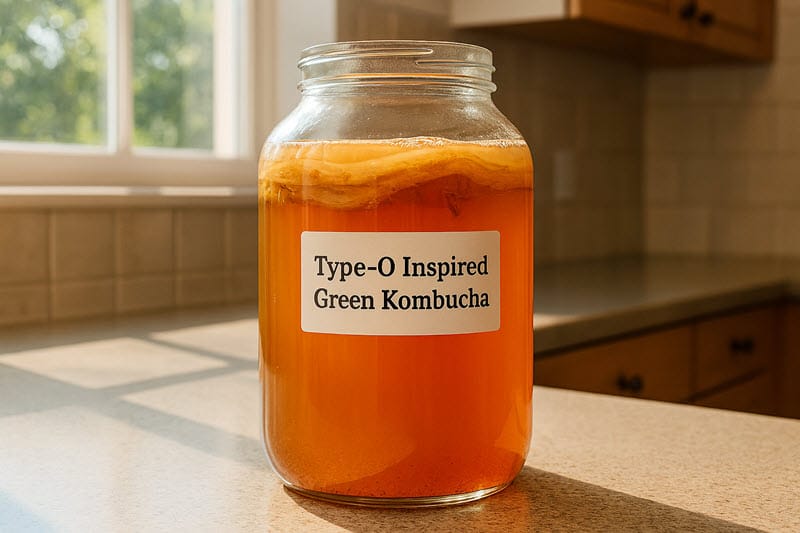
Fermented foods like this green‑tea‑based kombucha can be a tasty way to support everyday wellness: the live cultures formed during fermentation may help maintain a healthy gut microbiome, while organic acids (such as acetic and gluconic acids) and B‑vitamins produced in the brew can aid digestion and make the drink feel naturally refreshing with less residual sugar than the starting tea. Crafted for readers following Dr. Peter J. D’Adamo’s guidance for Blood Type O, this recipe skips black tea and leans on gentle green teas (e.g., bancha, genmaicha, or kukicha), aligning with his recommendation that Type O individuals avoid black tea while still delivering the crisp, bright character people love in kombucha. As with any fermented food, individual tolerance varies—so start small and pay attention to how you feel.
Kombucha Blood Type O
Kombucha Blood Type O
A green-tea-based kombucha crafted for Blood Type O—skips black tea in favor of gentle green, white, and oolong teas, then flavored with mango and cayenne.
Ingredients
Equipment
- 1-gallon glass jar
- Coffee filter + rubber band
- Swing-top glass bottles
Method
- Steep the tea. Bring 2 cups water to a boil, add all the teas, and steep. Stir in 1 cup organic cane sugar until dissolved. Cool to room temperature and remove the tea leaves or bags.
- Pitch the SCOBY. In a 1-gallon glass jar, combine 3 quarts room-temperature water, the 2 cups sweet tea, the SCOBY, and 1 cup starter tea.
- First ferment. Cover the jar with a coffee filter secured by a rubber band. Set on the counter out of direct sunlight and ferment 6 days.
- Second ferment. Pour the fermented kombucha into swing-top glass bottles with a little mango juice and a pinch of cayenne. Seal and let carbonate 1–3 days, then refrigerate.
Notes
- Plus about 6 days for the first ferment and 1–3 days for the second (flavoring) ferment.
- Crafted for Blood Type O—skips black tea and uses gentle green teas per Dr. D’Adamo. See the Blood Type O tea and juice lists below.
Where it lands on the Intestinal food lists
A functional drink like this leans on supplements and superfoods that predate Mein’’s 1997 food lists, so only some ingredients map — here’’s how those score for the Intestinal body type:
Every mapped food sits at “Moderately” for this type — fine in rotation, not a daily staple.
- Green tea Moderately holds under stress
- Chinese oolong tea Moderately holds under stress
- Refined cane sugar Moderately
Scored against Carolyn Mein’s Intestinal Profile. See the full Healthy vs. Sensitive crosswalk.
Highly Beneficial Teas and Juices for Blood Type O
Teas
- Cayenne tea
- Chickweed tea
- Club soda
- Dandelion tea
- Herbally Grounded $31.68 per lb
- Fenugreek tea
- Gingerroot tea
- Green tea (bancha, genmaicha, kukicha)
- Hops tea
- Botanical Name: Humulus Lupulus
- Herbally Grounded $46.08 per lb
- Linden tea
- Mulberry tea
- Parsley tea
- Peppermint tea
- Herbally Grounded $23.68 per lb
- Rose hips tea
- Herbally Grounded $22.08 per lb
- Sarsaparilla tea
- Seltzer water
- Slippery elm tea
Juices
- Black Cherry juice
- Blueberry juice
- Cherry juice
- Guava juice
- Mango juice
- Pineapple juice
- Prune juice
- Vegetable juice (from Highly Beneficial vegetables)
Neutral Teas and Juices for Blood Type O
- Catnip tea
- Chamomile tea
- Dong quai tea
- Elder tea
- Ginseng tea
- Goji berry tea
- Hawthorn tea
- Horehound tea
- Licorice root tea
- Mullein tea
- Peppermint tea
- Raspberry leaf tea
- good replacement for black tea
- Herbally Grounded $41.28 per lb
- Sage tea
- Skullcap tea
- Spearmint tea
- Thyme tea
- Valerian tea
- Vervain tea
- White birch tea
- White oak tea
- Yarrow tea
- Yerba Maté tea
Juices
- Apple cider
- Apple juice
- Apricot juice
- Beet juice
- Cabbage juice
- Carrot juice
- Celery juice
- Coconut water
- Cranberry juice
- Elderberry juice
- Grapefruit juice
- Grape juice
- Lemon and water
- Lime juice
- Milk, almond
- Milk, rice
- Milk, soy
- Nectarine juice
- Noni juice
- Papaya juice
- Pear juice
- Pomegranate juice
- Tomato juice
- Vegetable juice (from Neutral vegetables)
- Watermelon juice
- Wine, red
Avoid these teas for Blood Type O
- Alfalfa tea
- Aloe juice
- Aloe tea
- Beer
- Blackberry juice
- Black tea, all forms
- Burdock tea
- Coconut milk
- Coffee
- Coltsfoot tea
- Corn silk tea
- Cucumber juice
- Echinacea tea
- Gentian tea
- Goldenseal tea
- Liquor, distilled
- Orange juice
- Red clover tea
- Rhubarb tea
- Saint John’s wort tea
- Senna tea
- Shepherd’s purse tea
- Soda, pop (such as colas and diet colas)
- Strawberry leaf tea
- Tangerine juice
- Wine, white
- Yellow dock tea
Caffeine Ranges
| Beverages, Tea, and Coffee | Caffeine in 8 oz (240 mL) |
| Red Rooibos tea | 0 mg |
| White tea | 15-30 mg |
| Green tea | 20-45 mg |
| Oolong tea | 30-55 mg |
| Mountain Dew (classic) | 36 mg |
| Black tea | 40-70 mg |
| Yerba Mate tea | 70-80 mg |
| Coffee | 80-100 mg |
| Monster Energy | 80 mg |
| Mountain Dew Energy | 90 mg |
Additional Information
If you have any questions, don’t hesitate to get in touch with me on my Contact Page
The next blog post I recommend you read Potassium Drink