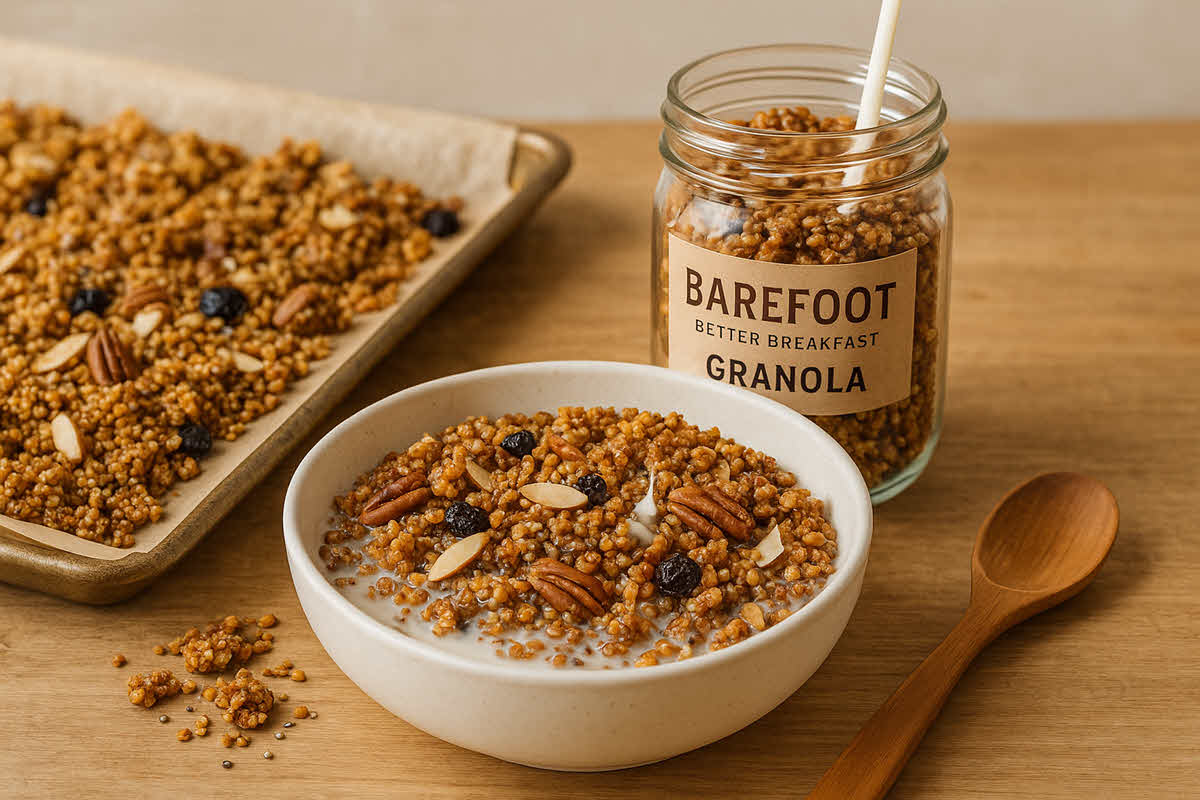
Barefoot Better Breakfast Granola is a delicious, anti-inflammatory powerhouse that stabilizes blood sugar and nurtures your gut. Using pressure-cooked quinoa, flax seeds, chia seeds, almonds, pecans, and inulin, it delivers fiber, omega-3s, and prebiotics to reduce inflammation and promote digestion. Enhanced with Ceylon cinnamon and your choice of raisins or dried blueberries (if available), this low-sugar, Dr. Steven Gundry’s Plant Paradox-approved granola minimizes blood sugar spikes while offering a crunchy, nutty flavor boosted by almond extract. Enjoy it with almond milk or coconut yogurt for a barefoot-inspired breakfast that fuels your vibrant lifestyle.
Barefoot Better Breakfast Granola
Barefoot Better Breakfast Granola
A Plant Paradox-friendly, anti-inflammatory granola of pressure-cooked quinoa, pecans, almonds, flax, and chia—lightly sweetened and baked into crunchy clusters.
Ingredients
Equipment
- Pressure cooker
- Baking sheet with parchment or silicone mat
Method
- Pressure-cook the quinoa. Rinse 1⅓ cups dry quinoa well to remove saponins. In a pressure cooker, combine with 2 cups water and cook on high pressure . Natural release , then drain. Spread on a towel to dry (~) and pat dry for crispness.
- Preheat the oven to 325°F (165°C). Line a baking sheet with parchment paper or a silicone mat.
- Mix the dry ingredients. In a large bowl, combine the quinoa, pecans, almonds, flax, chia, coconut flakes, cinnamon, turmeric, ginger, and salt. Stir well.
- Combine the wet ingredients. In a small bowl, whisk the melted coconut oil, maple syrup, monk fruit, inulin, vanilla, and almond extract until smooth.
- Mix. Pour the wet ingredients over the dry and stir thoroughly to coat evenly.
- Bake. Spread thinly on the sheet and press lightly with a spatula for clusters. Bake , stirring every , until golden brown.
- Cool. Let cool completely (~) to form clusters, then stir in the raisins or dried blueberries to keep them chewy.
- Store in an airtight container in the fridge up to 1 month (flax, chia, and inulin keep best refrigerated).
Notes
- Plant Paradox-friendly and low-sugar; pressure-cooking the quinoa reduces lectins and saponins.
- Enjoy with almond milk or coconut yogurt.
Where this granola lands on the Intestinal food lists
This original recipe was built on Dr. Gundry’s Plant Paradox, not Carolyn Mein’s 25 Body Type System — so if you’re eating for the Intestinal body type, it’s worth seeing where each ingredient falls. Here’s how it scores against the crosswalk:
Mostly type-aligned, with one “Rarely” food this body handles poorly — keep that one occasional.
- Raisins Frequently
- Pecans Frequently
- Quinoa Moderately holds under stress
- Almonds (raw, roasted) Moderately
- Coconuts Moderately
- Maple syrup Rarely holds under stress
- Coconut oil Moderately holds under stress
- Sea salt Moderately holds under stress
Scored against Carolyn Mein’s Intestinal Profile. See the full Healthy vs. Sensitive crosswalk.
Most of it sits in the middle or lower tiers for this type: quinoa, coconut oil, and sea salt are “Moderately” on both lists; almonds and coconut flakes slide to “Rarely” when you’re run-down; and maple syrup is “Rarely” on both lists. That’s exactly why we built the Ancient Grain Granola — the same soak-and-bake idea, rebuilt on amaranth, basmati, walnuts, dry-roasted cashews, sorghum, date sugar, and butter, foods that sit in the Intestinal type’s top “Frequently” tier. If you swap the raisins for dried blueberries here, note those drop to “Rarely” on the Sensitive list.
Not on Mein’s 1997 lists (modern additions, or seasoning-level amounts): flax seeds, chia seeds, inulin powder, monk fruit sweetener, Ceylon cinnamon, turmeric, ginger, vanilla extract, and almond extract.